
🎙️ | Japan's Bubble with Rei Saito
Ep. 58


In this conversation, we do deep dive into the bursting of Japan’s economic bubble in the ‘90s. Uncovering Japan’s lost decade, the tragic tale of the economic bubble burst and its consequences.
Joining me for this deep dive is friend and previous guest, Rei Saito (@Misosoppa). Rei is the writer behind Konichi-Value. Konichi-Value aims to share my most valuable lessons from working in Japanese finance, and gold nuggets in the Japanese stock market.
So please enjoy this deep dive into the bursting of Japan’s economic bubble with Rei Saito from Konichi-Value.
Listen to this episode on Apple Podcasts, Spotify, Stitcher, Castbox, Google Podcasts, or on your favourite podcast platform.
My takeaways and lessons:
Japan’s bubble really was something else
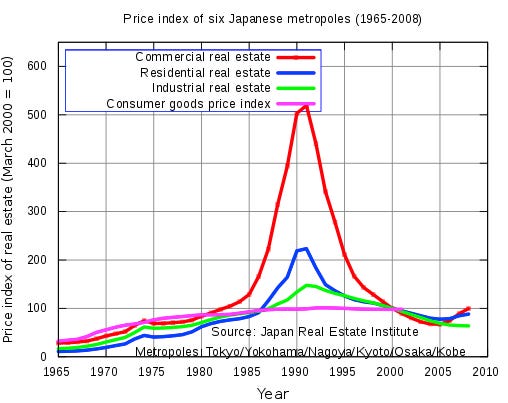
“13 of the 20 most valuable global corporations in 1989, right at the peak of the Japanese bubble, were Japanese. So, more than half of the 20 largest companies in the whole world were Japanese. On top of that, the asset bubble. So, the property prices, we talk about 2008 as a horrible time in the US but in the early 90s, Japanese property prices were almost double of American property prices in 2008 in the largest cities. So the bubble was twice as big in Japan as it was in 2008 in the US which is unfathomable. One fact I really love is that Japan is quite a small country, especially if you’re from Australia. I read somewhere it’s the size of California. All the land in Japan was worth more than all the land in the US at its peak. The Imperial palace, which is like a couple of football fields, you can literally walk around it in half an hour, that place alone was worth more than California.”
Banks + Bad Loans = Bonkers
“banks were sitting on horrible loans that they had to collect because a lot of companies were going bankrupt and they couldn’t because first of all, the loans were not nearly as valuable now after bubble had popped, but then on top of that, they had overvalued the overvaluation, so they were really screwed in that sense. And then also, you didn’t have any whistleblowers in Japan, partly because in Japan everybody follows the same way. But also, it was such a systematic problem, that a lot of employees in banks were holding these loans personally. So, their personal wealth was connected to these horrible loans. So there was no incentive for anybody to be a whistleblower because not only would they lose their reputation, but also they would lose all their money. So banks went hardcore in trying to get emergency loans from the government so they could give emergency loans to the companies that they were supporting. So we got this weird situation where we got tons and tons of what we now call zombie corporations which is basically these companies have a huge debt burden and the only reason they are still alive, even though they’re very inefficient and poorly run, is because they get these cheap or free loans from banks that are in turn supported by the government.”The reports of Japan’s death are greatly exaggerated
“The old, tried and true tale which people love to read about Japan. It’s like, ‘the country that was in the future, but now it’s stuck in the past, and everybody’s old and dying, and all the companies, they were great and now they’re horrible, and nothing ever changes’, end of story. Japan will just sail into the sunset and we will all forget Japan ever existed in ten years. It’s not true. When you live here or when you come here, you realize that Japan has evolved a crazy amount since the 1990s. First of all, just being in Tokyo or Osaka, wherever you go as a tourist, you can just see the difference, how Japan has changed and how much cleaner and more structured Japan is than ever before. If you look on a more ground level, on a more framework level, Japan’s legal framework is immensely better. The government has really cleaned up a lot of things and to be fair, I think in Asia, except for maybe Singapore, there’s no other country that has a better or stronger legal framework.Don’t try to put Japan in a box
“I think people have a fixed image of Japan, and then they try to factor everything into that image. There’s a lot of conflicting faults. People always say, Japanese people don’t like to make decisions, or they’re very scared of thinking outside the box but then you also have the wackiest and craziest stuff all coming from Japan, and you’re like, how does that make sense? I feel like there’s a lot of these paradoxes that people have a hard time with.”
Mentioned/Recommended Content:
Show Notes:
[00:00:31] – [First question] – Why write about Japan’s Lost Decade?
[00:02:38] – Rei’s memories of the bubble
[00:05:07] – How did Japan’s bubble develop?
[00:11:34] – As the bubble popped, how did the Japanese government step in and what did they do?
[00:13:08] – Japanese Banks and the bubble
[00:16:20] – The fiscal structural reform law and why it stunted Japan’s recovery
[00:18:48] – How intertwined Governments and Corporations were
[00:24:52] – Judging Japan’s recovery
[00:29:25] – The media’s portrayal of Japan
[00:31:48] – Wrapping up
[00:32:56] – Extra resources to understand Japan’s Bubble years
[00:34:33] – Rei’s upcoming work
Connect with Rei:
Transcript
[00:00:31] Kalani Scarrott: Today’s episode is a deep dive into Japan’s economic bubble of the 90s. So, we’re going to uncover Japan’s lost decade, the tragic tale of how the economic bubble burst and its consequences. So, joining me for today’s episode is a friend and previous guest, Rei Saito. So, Rei is the writer behind Konichi-Value. Konichi-Value aims to share the most valuable lessons from working in Japanese finance, as well as some gold nuggets in the Japanese stock market. Rei’s post on Japan’s economic bubble was a great primer for this, and so I wanted to pick his brain and learn some more and share it in a podcast format. So, I hope you have as much fun as me and please enjoy this deep dive into the bursting of Japan’s economic bubble with Rei Saito from Konichi-Value.
Thanks for coming on. Appreciated by millions, you came to do a deep dive on Japan’s bubble. So, your article, I thought was specifically good about the political backdrop surrounding Japan’s lost decade. So, you don’t come across that too often. Most of the time, it’s purely about economics but in the first place, what made you decide to write about it?
[00:01:38] Rei Saito: That was a journey and a half. It’s one of those rabbit holes where you think you know what it is until you step inside it. The material, especially in Japanese, that’s written about bubbles. You could fill a whole library, to be honest. But I think just like you, probably. Most people have heard about the bubble and most people have heard about this, like, crazy 80s Japan but I don’t think they understand the scope of the insanity the bubble was and how it actually was one of the biggest bubbles in world history of any country. So, living here, I realized that everything that happens in Japan, in politics, economics, or even how people react, it’s all connected to this era, the bubble era, because it was so big for Japan. I feel like I couldn’t continue a blog on Japanese business without digging deep into the Japanese bubble.
[00:02:38] Kalani Scarrott: I’m trying to work backwards here, going through your LinkedIn to find your age, but as we discussed in our previous podcast, you’re born in rural Japan and even though you grew up mostly in Sweden, you did attend elementary school in Japan. So, I’m just curious about you and your experience. So, what were your first memories of Japan’s bubble and is there anything that sticks out either to happen to you, friends or family?
[00:03:02] Rei Saito: I think you probably did a pretty good detective job because I was born in Kumamoto, Japan, which is quite a rural place by Japanese standards. I was born right before the bubble burst. Honestly, looking back, I’m pretty grateful that my parents didn’t raise me in Japan because our generation were the unlucky ones. I released an article yesterday about the lost generation. They’re a little bit older than me but almost the same generation. It’s the people who grew up in a Japan where everyone’s looking at the past for greatness and that generation got the worst end of the stick. They got the aftermath, they didn’t get the jobs they wanted, even though they studied harder than any other generation. Whenever they looked at the present or the future, everything looks bleaker and bleaker. So, I think the memories I have from elementary school, even though I was very young, so they’re not super clear, but I still remember it being so tough. I went to Swedish school a little bit and then Japanese elementary school, and it’s like a work week, but you also work on Saturdays when you’re seven years old, so you go to school Monday to Saturday and cram any kind of information. You’re always told, even when you’re that young, that you have to learn this otherwise you will be useless in society. I feel like that’s the group I grew up with. You have to be good enough just to be a part of Japanese society. So it was quite a rough start for Japanese people. As a half Swede, I think I got the much easier end.
[00:05:07] Kalani Scarrott: We’re completely opposite in Australia. So with the article and talking about the buildup of the bubble, as you wrote, Japan was on the verge of surpassing the United States as the world’s largest economy basking in the glow of seemingly endless prosperity. So it’s a hard task and a big one. But how did Japan get to this point in the first place of nearly surpassing the US?
[00:05:26] Rei Saito: You are asking really big questions here. Honestly, first of all, this question could fill a whole lot of Podcasts, so I’m going to try to simplify a bit. Right. So, it’s hard to grasp how big Japan was and how much on everyone’s mind it was. But imagine in the 80s, like today we associate this to Asia. We associate China, Taiwan, Korea, and even India. It’s like these countries of incredible growth and where the growth engine comes. But in the 80s it was only Japan. Japan stood for all those things. So, you say the world’s factory, today is China. Back then, it was only Japan. The world’s most advanced technology, Japan, and the world’s most efficient labor force, Japan. The world’s growth engine, which we now attribute to India and China, also Japan. I think it wasn’t even that far off, especially in the 60s and 70s, you had companies like Cannon, Honda or Toyota who just destroyed the Western competitors. I know your colleague or friend, Asianometry, he talks a lot about Japanese semiconductors. They were truly the greatest and Americans were shocked that Japan had taken that industry by storm out of nowhere. That was really Japan. They just came in and demolished the competition and I think that held absolutely true. Japan was on a good trajectory right up until the 80s. So in the 80s, things kind of spiral out of control. There are many reasons for this. You may have heard about the Plaza Accord as a big thing. People should Google it if you want to know more but things like that made the Japanese government regulate banks a lot. And also the yen started appreciating at the time. So everything in Japan just naturally got valued higher. As a result of these increased liquidity and a super positive sediment that has been going on in Japan at that time for 30,40 years straight, It was an uptick in stocks and property prices that accelerated enormously from previous decades. I think what’s super interesting here is that with normal bubbles, you see governments and central banks hopefully trying to calm the market a bit by increasing interest rates or raising taxes but Japan at this time, they were doing the opposite. And then you had Japanese companies flexing even more at that time, like there’s a good story about Toyota, they made 50 year forecasts and they started to publicly announce these 50 year forecasts of how many cars they were going to sell in 2020, basically right now. At that time, because Japan was so confident and people that invested in Japan were so confident, they believed it. So they were like GM, they do five-year forecasts while Toyota does 50-year forecasts, they should be valued 50 times more. All these Japanese companies got valued into the heavens and so you have foreign investors being super positive, Japanese investors being even more positive, and then the government cheering you on and saying you should be even more positive. We’re going to make sure to make it even better. That turned Japan into the craziest bubble in history. Do you want to hear some statistics of how crazy it was? First 13 of the 20 most valuable global corporations in 1989, right at the peak of the Japanese bubble, were Japanese. So, more than half of the 20 largest companies in the whole world were Japanese. On top of that, the asset bubble. So, the property prices, we talk about 2008 as a horrible time in the US but in the early 90s, Japanese property prices were almost double of American property prices in 2008 in the largest cities. So the bubble was twice as big in Japan as it was in 2008 in the US which is unfathomable. One fact I really love is that Japan is quite a small country, especially if you’re from Australia. I read somewhere it’s the size of California. All the land in Japan was worth more than all the land in the US at its peak. The Imperial palace, which is like a couple of football fields, you can literally walk around it in half an hour, that place alone was worth more than California. People were insane when you say it out loud, this is how it even works but that’s how crazy Japan was at the time.
[00:11:04] Kalani Scarrott: You even add to the fact of where they were 20, 30, 40 years prior to that, the insane rise. It happened so quickly. I wish I could have seen it in real time because you wonder if you get swept up in the mania, you start believing all the hype.
[00:11:27] Rei Saito: We see time and time again, this time it’s different. That’s always the number one rule.
[00:11:34] Kalani Scarrott: Do you want to talk a bit about the bubble popping and as the bubble popped, things weren’t looking good but how did the Japanese government step in and what did they do?
[00:11:46] Rei Saito: So the bubble popped, started around 1991, trickled into 1993 and it got worse and worse. The Japanese government, they could see the writing on the wall, but they’re a very conservative government. So, they started with what governments do. They started to reduce income taxes a bit. They fired up some public works, and it might have worked if it wasn’t the largest bubble in history. So, it didn’t do anything, like building a new tunnel in the middle of nowhere. It was like putting a band-aid on an open wound. It was way too little and way too late. So when bankruptcies started piling up, the Japanese government started realizing more and more how bad it really was and they panicked a bit too. So they started bailing out companies and banks left and right, and they gave lifelines to any company or bank big enough or connected enough to have an impact on the Japanese economy. So, it’s hard to understand how much trouble the government was having and they panicked because any government would, but they really didn’t have a plan. They really didn’t think the bubble was going to pop.
[00:13:08] Kalani Scarrott: It’s the biggest bubble in history, it’s such a mess. What do you even do? So, the government’s in strife. The one I found interesting was Japanese banks and the mess they were in. So, billions in collateral but then not being able to collect it. So, you want to talk about that and explain that?
[00:13:25] Rei Saito: That’s quite common. It was the same in 2008. You have all these banks holding horrible loans, a mask that’s better loans. Japanese banks were also going haywire with this in the 80s. First of all, properties were, as you saw, very expensive already but there was practices in many Japanese banks at the time, almost all Japanese banks, where they would prop up the value of companies and properties even more than they were valued in the bubble, so they could give out more loans and make their balance sheet look bigger. This is illegal. Japan is not completely, you can do whatever you want, but it was systematic in the end, as long as things went up, it’s very easy to believe that you overvalue something and hopefully the thing grows into the valuation and then boom, you’re scot free. You were just like ahead of the curve but when the bubble started popping, it was really bad because all these banks were sitting on horrible loans that they had to collect because a lot of companies were going bankrupt and they couldn’t because first of all, the loans were not nearly as valuable now after bubble had popped, but then on top of that, they had overvalued the overvaluation, so they were really screwed in that sense. And then also, you didn’t have any whistleblowers in Japan, partly because in Japan everybody follows the same way. But also, it was such a systematic problem, that a lot of employees in banks were holding these loans personally. So, their personal wealth was connected to these horrible loans. So there was no incentive for anybody to be a whistleblower because not only would they lose reputation, but also they would lose all their money. So banks went hardcore in trying to get emergency loans from the government so they could give emergency loans to the companies that they were supporting. So we got this weird situation where we got tons and tons of what we now call zombie corporations which is basically these companies have a huge debt burden and the only reason they are still alive, even though they’re very inefficient and poorly run, is because they get these cheap or free loans from banks that are in turn supported by the government. So this is how the situation was kept alive for a very long time and maybe you didn’t see the craziness of even 2008 in the US. Because the Japanese company went down like it never crashed. This is the sole reason that the government was trying to keep everything alive as long as it could.
[00:16:20] Kalani Scarrott: Using the band-aid analogy, sometimes you must rip the band-aid because of some damage and then repair it. You’ve also written about zombie companies, which I’ll be sure to link because that was a great article, too. One piece in your article was about the Fiscal Structural Reform Law. Why did that stunt Japan’s recovery, could you explain that?
[00:16:38] Rei Saito: I didn’t know about this until my mom told me about it. I remember because I was in Japan at that time and Japan had a 0% VAT for the longest time, so you paid nothing for any goods you bought. In Australia, I don’t know how much it’s around 15%, 20% (GST 10%). In 1997, they raised it to 5% and it was this classic where you had to calculate it yourself. So you bought something and then you got more money on top. So it angered a lot of people at the time, but this was a whole package in 1997. It was a new cabinet in the government, and they were seeing how the unsustainable loan in practice had made the government deficit sky high. It rose from like 40% in the 80s to over 100% in less than five years. Now 100% doesn’t sound so bad for Japan because they’re almost up to 300% but at that time it was crazy. So, the government panicked. They were like, we need to call the investors and they started with tax packages. So, they’re going to restore the fiscal balance in no time. So, they raised health care prices, raised corporate taxes, and raised the VAT or GST. It was the worst timing because the economy hadn’t recovered at all. So all of a sudden you have people who earn less money than they did five, seven years ago and now they’re taxed more heavily, the same with corporations. So people stop buying more stuff because VAT is now more expensive, people have less income to spend and corporations are starting to save more money because of the raised corporate taxes. So you went into a double dip recession where the recession got even worse because of these tax reforms.
[00:18:47] Kalani Scarrott: How intertwined were our businesses and the Japanese government. So he gave a great example in the article of Long Term Credit Bank of Japan and how they managed to stay afloat. How and why did these sorts of situations occur?
[00:19:05] Rei Saito: You talk to a lot of people in Asia and they can all tell you that in Asia, governments and corporations often have quite cozy relationships, for better or worse. In the west, we like to point at China and be like, Huawei is so corrupt, disgusting. But to be honest, this is the reason why Asia has been able to grow, especially East Asia has been able to grow so fast. Companies like TSMC, no way would they be able to exist without the help of the government. Companies like Samsung. These companies would never exist without the help of the government. So I think it’s very important first to lay out the groundwork that having a closer relationship with the government is not necessarily a bad thing. It’s often a pretty good thing but if times are tough, if things go badly for the company, or if the company is badly run, it can go south very quickly. I like that you took up the LTCB (Long Term Credit Bank) because it is a very interesting example of when the thing we fear in the west, the close relationship with the government and companies, when that is bad, LTCB is a prime example. So you have this bank, it’s quite a good bank to start with. It was always close to the government. It was created by a former prime minister, Shigeru Yoshida, in 1952 and it was a bank that was going to help with industrializing Japan. So they would give out stable and long term loans to Japanese industries so they could grow, which is a beautiful thing and every developing country needs it. They were doing a very good job for a very long time and therefore they also got probably too cozy with the government but still they were going up slowly and surely until the 1980s. When all the banks in Japan went crazy with loaning to everybody and anybody, and they had this, we should be the stable bank. We should be the bank that is fiscally responsible. I haven’t read too much into it but there was some new leadership or some new people that wanted to push a new agenda and they obviously saw what the other banks were making, so they went all in. So they started buying up assets in Japan for crazy prices but they didn’t stop there. They started buying assets in Australia, assets in Sydney, New York, London, Singapore, anywhere they could get a hands on overvalued assets. It got so bad that in the late 1980s, they were the 9th largest bank in terms of holding assets in the whole world. So we’re talking about a conservative bank that’s called the Long Term Credit Banker, a boring bank that’s now the 9th largest bank in the world and probably holding the worst loans in Japan while being the bank that’s most strongly connected to the government. So you have this issue and then on top of that, the politicians have asked for multiple favors from the bank. For example, the bullet train in Japan, Shinkas, and there’s routes that don’t make any sense that were probably built because some politicians wanted some votes from a municipality. You have a bunch of tunnels in nowhere that still exist and have to be maintained and also supported by LTCB. All these crazy things are supported by this one bank, which is now not only having horrible assets abroad, but also helping the party to win by holding horrible assets inside Japan. So when the crisis hits, the bank goes sideways very quickly, but it never defaults. We Don’t know much about what happened because the government still holds many documents in secret and I haven’t been able to find much information but the truth is it was kept alive by the government. The Prime Minister at the time directly helped with selling off assets from the bank and splitting it up. And still this because there’s probably a lot of corruption involved. We don’t know what the government did to be able to sell these assets, but any rational person would probably not buy them. So we can only assume that the government did a lot of favors for a lot of people to be able to sell off these assets. I think the last interesting part is that, in a very Japanese fashion, you might say nobody got convicted for anything. So no top executive was ever convicted but there were still smear campaigns in the media. There were a lot of angry people who lost a lot of money. At the end, just months after the final court conviction or non-conviction, two executives committed suicide. So it’s very Japanese in the sense that the court of the people, the walk of shame, is so much stronger than the actual courts in the country.
[00:24:38] Kalani Scarrott: What a story. At least we need a movie about it. How would you rate or even judge Japan’s recovery?
[00:25:03] Rei Saito: I’ll try my best; it is the million dollar question. To be honest, I want to start on the positive notes, which I think is very forgotten. I dislike reading a lot of the western storyline, I’d call it. There was a sorry, for example, an article in the BBC by Rupert Wingfield-Hayes, he’s lived in Japan for many years, even though he doesn’t speak any Japanese on either one. You should link to it because it’s his last article, it got on the top ten articles on BBC News and it’s him because BBC is leaving Japan. So I guess they made him a favorite, and he wrote a story of how was living in Japan. It’s so annoying because he writes the old, tried and true tale which people love to read about Japan. It’s like, the country that was in the future, but now it’s stuck in the past, and everybody’s old and dying, and all the companies, they were great and now they’re horrible, and nothing ever changes, end of story. Japan will just sail into the sunset and we will all forget Japan ever existed in ten years. It’s not true. When you live here or when you come here, you realize that Japan has evolved a crazy amount since the 1990s. First of all, just being in Tokyo or Osaka, wherever you go as a tourist, you can just see the difference, how Japan has changed and how much cleaner and more structured Japan is than ever before. If you look on a more ground level, on a more framework level, Japan’s legal framework is immensely better. The government has really cleaned up a lot of things and to be fair, I think in Asia, except for maybe Singapore, there’s no other country that has a better or stronger legal framework. It is interesting that people don’t know that Japan, for finance people, is the safest haven. That’s where people want to put their money. When Hong Kong people can’t invest in Hong Kong for whatever reason, they come to Singapore but also to Japan. No other country. It’s because Japan is now a really good country for business and a country that has really evolved. Japan is still the world’s third largest economy. That’s not a small feat, sure China surpassed Japan like 15 years ago, but they have a billion plus people and Japan has a shrinking population. So it’s just like keeping this economic momentum going means that you have a good corporate base that produces a lot of good things year in and year out. Now it sounds super positive about Japan and I think there are definitely some negative sides. As I said, the government deficit is the highest in the world in percentage and it’s massive. It doesn’t look like that’s going to change anytime soon. A lot of it is because these bad loaning practices I talked about before, they never really stopped. So Japan, yes, they let some companies go bankrupt, but especially since COVID there’s a lot of unproductive so called zombie companies and zombie banks still alive and well in Japan. It’s something that the government will need to clear up one day because it sounds sustainable. These companies don’t make any money, they don’t pay any taxes and they still get free stuff from the government. I think whoever has to clean this up, his or her political career is over. So it’s one of those things that Japan is so good at, kicking the can down the road. I think that’s the negative I would put on Japan that has destroyed the image of Japan in many ways and which I think is one of the biggest issues Japan has and probably why you can write an article about how stagnant Japan is and be at least 40, 30% right and get away with it.
[00:29:25] Kalani Scarrott: Yeah, it’s in the BBC article. This is slightly off topic. It’s strange how much of a bang that Japan is for just terrible takes. I saw one today on Twitter, some dude, and he got heaps of engagement, but the guy was like, oh, I’ve been to Japan, and everyone was in a rush and didn’t want to chat or they’re in a bubble. Some guy commented, oh, where’d you go? Tokyo. No wonder if you go to a megacity, people are in a rush. I just don’t even have words sometimes but it’s the nature of the beast.
[00:29:59] Rei Saito: I think it’s also because of the media’s portrayal of Japan. I think people have a fixed image of Japan, and then they try to factor everything into that image. There’s a lot of conflicting faults. People always say, Japanese people don’t like to make decisions, or they’re very scared of thinking outside the box but then you also have the wackiest and craziest stuff all coming from Japan, and you’re like, how does that make sense? I feel like there’s a lot of these paradoxes that people have a hard time with. When they read an article, Japan is stagnant, nothing changes and then they go to the TeamLab exhibition, it’s one of the coolest arts exhibitions in the world. It’s in Odaiba and they have a Mori Art museum too now. These paradoxes exist because a lot of the things you think about Japan are simply not true. So I hope that I can get the message out with a lot of other people that Japan is very different from what most people believe.
[00:31:14] Kalani Scarrott: So, that’s one thing I don’t know if you know, I did an episode with unseen Japan guys, and that’s one bit they really hit on and are passionate about too, which I totally agree with, if I notice it and I’m not from Japan or I don’t speak the language, I notice how bad some of the stakes are, I imagine how painful it is for you guys to see it every day.
[00:31:32] Rei Saito: The worst thing is when people who’ve been here for a week want to tell you how to fix Japan. That’s painful.
[00:31:48] Kalani Scarrott: So overall, is there anything we haven’t talked about today or missed about Japan’s bubble? Anything else you want to cover?
[00:31:53] Rei Saito: Now when the borders are open, you should come here. We should totally go skiing. But I think that goes out to all your listeners and all your views that you should come here to see Japan to get your own opinion about it because I think part of Japan is conservative and Japan has issues but when you come here, you really see the amazingness Japan has to offer, both in terms of the economy and food and views and people. I think that it gives you the idea that Japan is a very prosperous country with a lot of potential. To be honest, I’ve had many people come here, both friends and acquaintances, and so far, I don’t know a single person who has been disappointed by their trip to Japan. At least they haven’t told me.
[00:32:56] Kalani Scarrott: I echo your friend’s sentiments. It’s so good and that’s the thing, there’s something for everyone. There’s the food, culture, and the snow. It’s got everything you need. I cannot raise it highly enough. In terms of Japan’s bubble, have there been any books or other content, anything else you want to highlight or link to or there’s been influential, do you think people should check out?
[00:33:20] Rei Saito: I read to practice my Japanese about the crisis. I sadly don’t remember its name, but for your English listeners, I recommend ‘The Princess of the Yen’. It’s quite a controversial book about how actually America and Japan move towards the liberal markets. It’s a big part of why the economy never recovered. I also recommend David Pilling’s ‘Bending Adversity’. I think that’s one of the most famous books about the bubble and the aftermath, because he was a Financial Times reporter here and in contrast to Rupert Wingfield-Hayes, who is the BBC reporter, he actually speaks Japanese. So he understands Japan and you can see it in his book. He writes about Japan in a way that I can relate to as a half Japanese person. So I think that’s one of the best books about the financial crisis in Japan.
[00:34:33] Kalani Scarrott: For you personally and Konichi-Value, what are the plans from here, what are you curious about going forward and what can we expect? Give me some insight.
[00:34:45] Rei Saito: Well, yesterday I released a new article about the Lost Generation. I talked a little bit about today, which you can always find on KonichiValue.com, and I also made a video on YouTube for it. So also KonichiValue on YouTube, which you should definitely check out. YouTube is a very interesting medium and I really want to explore it more. So, please, if anybody sees it, just give me feedback because I’m very new to YouTube and cutting videos is tough. You see these, 20 minute documentaries on YouTube and you’re like, wow, this is great, I should do it myself. And when you do it, you’re just like, this is crazy but still, it’s fun. I also want to say, I’m working on quite a big project now too, about the Sogo shores house. So that’s the Japanese trading companies, companies like Mitsubishi or Hitachi, there’s tons of them. I’m trying to write an article about the history of them because it’s super interesting. They were the reason why the Japanese economy is the way it is and they were there from the beginning, from the 1800, when Japan opened up and became the country of today, both pre and post war Japan. So I think that’s the biggest thing I’m working on now but as always, I’m releasing articles two times a week. So, stay tuned.
[00:36:21] Kalani Scarrott: You’re prolific. I love it. I love your work and the Training House is very much looking forward to it. Rei, Thank you so much. Anything else where people can find you or you want to add?
[00:36:31] Rei Saito: Well, I’m always on Twitter with a weird handle, Misosoppa, and it’s spelled in a Swedish way, so you have to work a little bit to find me there and other than that, you can just mail me at rei@konichivalue.com. I tend to answer all my emails and a lot of people are asking for a specific corporate analysis, which I like to do but those do take many days, so I don’t think I can fulfill all of them.
[00:37:04] Kalani Scarrott: It’s always nice to hear ideas but sometimes there’s too many out there to take advantage of.
[00:37:08] Rei Saito: It’s really hard work to create content.
[00:37:15] Kalani Scarrott: Rei, thank you so much for coming on. I absolutely had a blast today. [00:37:20] Rei Saito: Me too, always a pleasure being with you. Thank you too, Kalani.